
Why trust is the only KPI that compounds? Clicks are cheap. Impressions are inflated. Awareness fades by morning. But trust? Trust outlasts campaigns, carries pricing power, forgives mistakes, and compounds quietly in the background — until it becomes the most valuable asset you have. While most teams celebrate engagement spikes, the best brands track belief.
This article challenges the traditional KPI stack, shows what trust actually delivers, and offers a real way to measure and operationalize it.
The Vanity Metric Trap
Why Traditional KPIs Look Busy but Miss the Point
Marketing dashboards are filled with numbers: impressions, bounce rates, click-throughs, social shares. But what if most of them are just noise? They track attention, not belief. Visibility, not conviction.
- Awareness ≠ Affinity — People might know your name but still not believe in your brand.
- Impressions ≠ Influence — Reach doesn’t equal resonance.
- Engagement ≠ Endurance — Likes don’t signal loyalty.
- Even NPS ≠ Trust — It’s a directional hint, not a trust proxy.
Attention is rented. Trust is earned. And only one compounds.
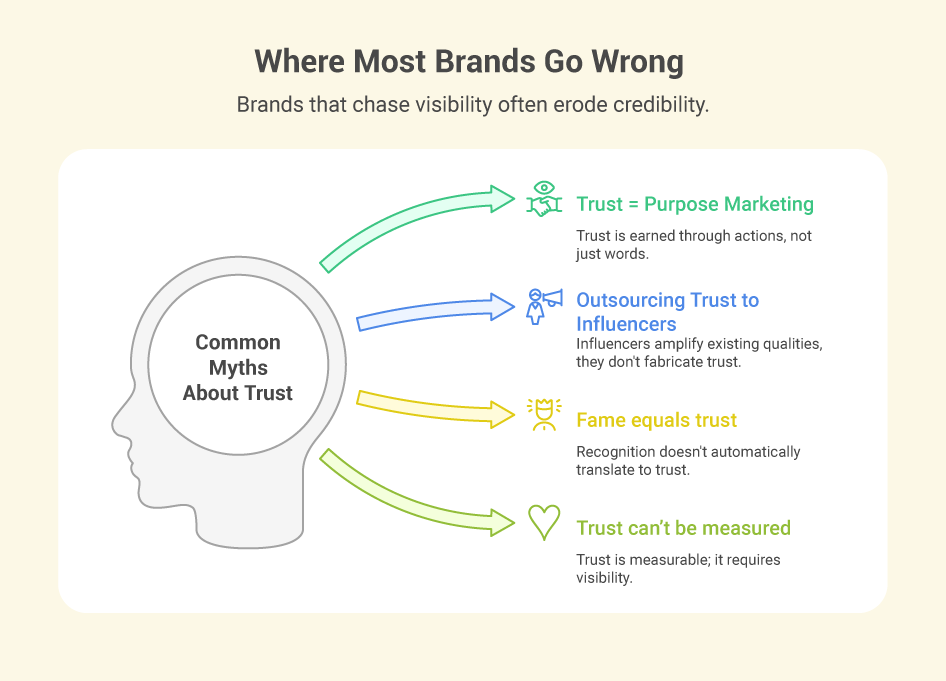
What Trust Delivers That Other Metrics Can’t
High-trust brands don’t just attract — they retain, convert, and compound. Here’s what trust unlocks:
- Retention: Customers stay longer and churn less. Trust anchors relationships.
- Referral: People share what they trust — not just what they like.
- Pricing Power: Trusted brands command premiums because belief reduces friction.
- Resilience: Trusted brands recover faster from mistakes; they get second chances.
- Team Magnetism: High-trust companies attract better talent and retain them longer.
Trust isn’t just goodwill. It’s the engine behind all your performance indicators.
Measuring Trust — For Real
Turning Trust into a KPI You Can Track
Trust feels intangible, but it’s measurable with the right lens:
- Net Trust Scores: Ask directly — “Do you trust us to do the right thing?”
- Behavioral Metrics: Track retention, repeat rate, referrals, forgiveness rate.
- Sentiment Signals: Measure positive reviews, brand mentions, organic advocacy.
- Claim → Evidence Mapping: Ensure every major brand promise has proof attached.
- Time-to-Trust: How quickly does a first-time visitor become a believer?
At PetriDish Media, we use our proprietary PETRI™ Framework to turn brand promises into proof-backed systems of trust — across language, cadence, and communication rhythm.
Start tracking. What gets measured gets strengthened.
Building a Trust-Led Operating System
What High-Trust Brands Do Differently
Trust-led brands don’t treat it as a marketing asset. They operate by it.
- They publish proof, not puff.
- Their tone is clear, not clever.
- Their values show up in product and service, not just press releases.
- Their teams are aligned — internally and externally.
- Their progress is timestamped and visible.
Trust isn’t a veneer. It’s a backbone.
From KPI to Operating Lens
Trust is not a campaign idea. It’s a strategic lens. It explains why:
- Your claim falls flat without proof.
- Your story collapses if it keeps changing.
- Your teams leak trust if they don’t align.
The smartest organizations don’t just ask “What’s working?” They ask “What’s earning trust?” Because at the end of the quarter, trust is the KPI that explains all the others.
Think you’ve built trust? Let’s test that.
At PetriDish Media, we help organizations align their brand, marketing, and communication signals — not just for visibility, but for trust velocity.
Share 3 of your top brand claims with us. We’ll trace:
- Where they show up
- How they’re evidenced
- Where trust might be leaking


