
Every time your team creates a new deck, writes a new post, or updates a product page without a language system, you’re doing extra work and you’re risking inconsistency at the same time.
Words aren’t just how brands communicate; they’re how brands behave. Language is another infrastructure when planned with care and governed with clarity, it becomes a multiplier. But when built on improvisation and isolated instincts, it quietly drains trust, time, and team energy.
Many brands today still approach messaging like it’s an art project. They brainstorm from scratch, each quarter, each function, each touchpoint. The result? Drift in tone, terminology and in clarity. And most dangerously—in trust.
The Case for a Language Bank
A language bank is more than a glossary or tone guide. It’s a living system that houses:
- Core brand phrases and terminology: These are the non-negotiable words and phrases that define your brand’s personality and positioning.
- Modular messaging blocks: Ready-to-use paragraphs and sentences that teams can drop into decks, landing pages, or emails.
- On-brand headline and copy templates: Structures and phrasing patterns for quick, consistent content creation.
- Tone and voice guardrails: Guidelines to help every communicator speak with the same voice, even across departments.
- Examples of correct (and incorrect) usage: Real use cases to show what good looks like—and what to avoid.
- Contextual cues for internal and external usage: Clarity on what language works where, so tone doesn’t shift unintentionally.
It bridges functions: brand, product, HR, comms, sales, leadership. It ensures that whether you’re speaking to a customer or an investor, a new hire or a policymaker, the language is aligned.
Without a Language Bank, Most Teams Rely on Memory or Muscle
That means smart people spend hours rewording what should be consistent. Worse, they contradict other departments unintentionally. One team uses “members,” another uses “customers.” One pitch talks about impact; another about speed.
This misalignment:
- Dilutes identity: When your language shifts from one channel to the next, your audience is left wondering what your brand actually stands for.
- Confuses audiences: Conflicting terms or tones make it harder for customers and stakeholders to connect with or trust your message.
- Slows down decisions: Every rephrasing becomes a debate, delaying execution across teams.
- Frustrates collaboration: Misunderstandings in language often lead to misalignment in goals, slowing teams down.
Over time, it becomes a silent tax on your brand.
Building One: It Takes More Than Documentation
A language bank isn’t just a style guide. It must be:
- Strategically rooted: The language must stem from your core brand promise and positioning—not just surface-level word choices.
- Context-aware: Every platform and audience has a different rhythm. A headline for your homepage won’t work in a support email.
- Tested for clarity and adoption: It should be easy to use, regularly updated, and validated by real usage scenarios.
- Governed: Someone must be responsible for maintaining, evolving, and training teams to use the bank effectively.
What Belongs in Your Language Bank?
Here’s a starter set:
- Brand promise, distilled into one declarative line: This becomes the north star for all messaging.
- Messaging themes (repeatable and defendable): Consistent narratives you use across campaigns, not just taglines.
- Approved descriptors: Words for your audience, product, service, and value propositions that everyone agrees on.
- Common objections and preferred language to counter them: Pre-crafted responses that build trust instead of triggering friction.
- Proof asset language: Decide how you refer to your case studies, testimonials, or customer success—and use it consistently.
- Tone and formality guardrails by channel: Define what “professional” means in an investor deck vs. on Instagram.
- A shared Claim → Evidence → Language table: This links the promises you make to how you phrase them and how you prove them.
This Isn’t Just Semantics. It’s Strategic.
In our work at PetriDish Media, we treat language as a trust system. It’s about being clear, believable, and consistent across time and team.
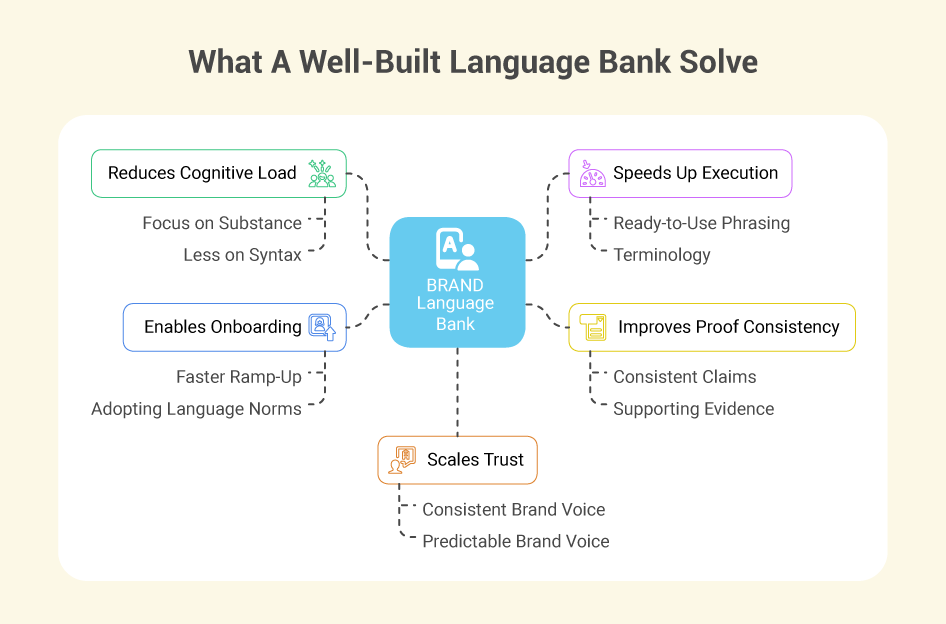
A language bank makes language operational. It ensures that your narrative doesn’t drift between functions or timelines. That no one has to reinvent your story when urgency strikes. And that everyone—from interns to CXOs—can speak with coherence.
Trust isn’t just built on what you say. It’s built on how predictably you say it. Language banks are the system behind that predictability.
Want to build your brand’s language bank? We help organizations like yours turn scattered messaging into usable, scalable systems. Connect with us to explore how to make your narrative speak with one voice, every time.
Fill out our contact form
or email us (use the subject line: “Language Bank – <Your Company>”).


